For localized information and support, would you like to switch to your country-specific website for {0}?


A biological window into disease activity
Our commitment
Navigating a complex and progressive disease requires more than a diagnosis
Multiple sclerosis (MS) is a complex, chronic, and evolving disease that affects more than 3.1 million people worldwide with a new diagnosis every five minutes.1,2 Around 85% of MS patients start with a relapsing-remitting form that may appear stable while underlying disease progression continues.3 Changes in disease activity often go unnoticed and can lead to irreversible lesions and disability.4
We are deeply committed to innovating across the care pathway with the focus on making the detection of disease activity more convenient and standardized to improve the outcomes for people living with multiple sclerosis. This opens the door to timely, effective therapy adjustments, ensuring that, in the future, no change in disease activity goes unnoticed. This gives people with multiple sclerosis and their families what is needed most: personalized care and stability.
Disease burden
The human and economic burden of multiple sclerosis
Because disease onset typically occurs in young adulthood and can lead to permanent, progressive disability, the impact extends far beyond individual physical symptoms, affecting emotional well-being, family dynamics, and global economic health.2,5,6 Key dimensions of MS disease burden include:
- Impact in peak life years: The global average age of diagnosis is 32 years.7 Onset typically strikes during early adulthood—a pivotal time when individuals are establishing careers, pursuing education, or starting families.
- Physical and progressive disability: Silent, ongoing neurological damage occurs continuously from disease onset—even when a patient appears clinically stable and has no active relapses.5 Without management, this accumulated damage leads to permanent loss of mobility and independence.
- Caregiver and family strain: As daily tasks become increasingly challenging, reliance on caregiving grows. This shift often places severe physical, emotional, and psychological stress on family members and caregivers.
- Economic and health system strain: MS demands lifelong medical resources. The financial strain encompasses high direct medical expenses (treatments, therapies, and specialized care) alongside indirect costs, such as loss of employment productivity for both patients and their primary caregivers.
Why timely action matters
Because underlying progression occurs from the very beginning of the disease, diagnostic delays directly compound physical disability and socioeconomic hardship. Closer monitoring for early detection and intervention remain critical to preserving long-term quality of life.
Diagnostic challenges and impact
Making the invisible visible: Closing the gap in MS disease monitoring
Neurological damage in MS patients begins early, often before visible symptoms emerge. This lack of visibility emphasizes the need for early detection and intervention, yet there are currently limited real-time tracking tools for MS disease activity.
Relapsing-remitting multiple sclerosis (RRMS) progression is often “under the radar”, with neuroaxonal damage occurring below the threshold of clinical symptoms or standard MRI detection. While MRI provides a retrospective view of cumulative damage, clinicians require a dynamic, quantitative measure of ongoing neuroaxonal injury.8-10
The current standard of care for MS diagnosis includes assessment tools that have high clinical utility but are costly and time-consuming, leading to accessibility issues. Alternative tools lack the standardization to detect subtle disease changes, limiting the accurate identification of disease activity and progression over time.3,11
There is a pressing need for a personalized approach, with accessible and scalable solutions to catch early signs of RRMS disease activity and monitor treatment response.12,13 By offering highly sensitive biomarker blood testing, laboratories can provide clinicians with an accessible tool to help frequently monitor subclinical disease activity, complementing traditional imaging.9,14
Featured products
IVD
For in vitro diagnostic use.
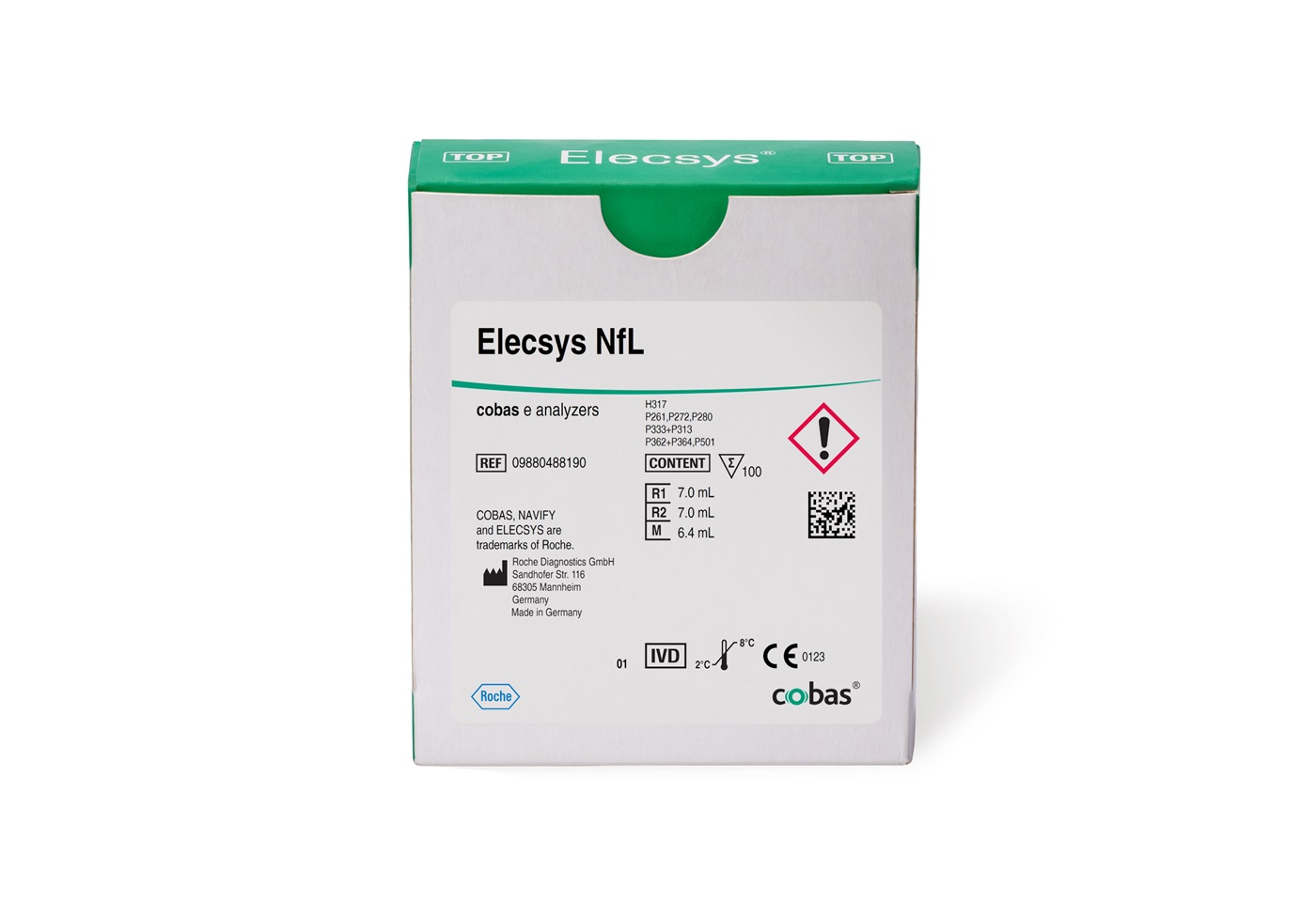
Elecsys® NfL
Elecsys® NfL blood test offers a minimally invasive, accessible complement to the traditional standard of care, enabling more frequent monitoring of a patient’s neuroinflammatory status.
Benefits of Roche diagnostic solutions for managing multiple sclerosis
Driving clarity
Clarity when timely and optimal patient management is critical
Time and accuracy are vital when evaluating pre-clinical signals to slow RRMS progression and preserve quality of life.15 Highly sensitive biomarker testing equips clinicians with complementary data between MRI assessments, supporting patients and caregivers more closely along the disease journey.14
Reflecting this clinical value, the Consortium of Multiple Sclerosis Centers (CMSC) recommends NfL measurement for evaluating and managing patients with MS.16 The Elecsys® NfL immunoassay is standardized and traceable to NIST, delivering reliable, quantitative measures of NfL in serum and plasma in just 18 minutes.15
Enhanced monitoring
Personalizing healthcare with accessible, frequent monitoring
While traditional MRI reflects cumulative structural damage at fixed time points, it can lag behind active neuroaxonal injury. Integrating minimally invasive NfL testing bridges this gap by enabling frequent, accessible monitoring of subclinical disease activity between routine scans—supporting timely reassurance or personalized intervention.9,14
Although a single serum NfL measurement provides a checkpoint, its greatest clinical power lies in longitudinal tracking. Serial measurements allows clinicians to predict future disease activity, assess relapse risk, and track brain atrophy over time, creating a dynamic, personalized approach to MS management.8,10,17,18
Automated precision
High-performance testing with cobas® technology
Fully automated processing across cobas® e platforms delivers high-precision results while reducing variability from manual handling. Roche cobas® diagnostic analyzers are designed to rapidly integrate into laboratory workflows.
The Roche Elecsys® NfL assay can be used on the automated cobas® e 801 and cobas® e 402 platforms, allowing labs to choose an instrument that meets their size and throughput requirements.14
Understanding MS activity and the role of NfL
playicon
videoCtrl
/
fullScreen
Update Required
To play the media you will need to either update your browser to a recent version or update your
Flash plugin.
This video explains how neurofilament light chains serve as a blood based biomarker to track the inflammation of nerve cells and disease activity in patients with Relapsing-Remitting Multiple Sclerosis.
Show video transcript
Explore more
References
King R, et al. Global prevalence of multiple sclerosis surpasses 3 million: 2024 update of the Multiple Sclerosis International Federation Atlas of MS. Mult Scler. 2026;13524585261479954.
Walton C, et al. Rising prevalence of multiple sclerosis worldwide: Insights from the Atlas of MS, third edition. Mult Scler. 2020;26:1816–21.
National Multiple Sclerosis Society. Relapsing-Remitting Multiple Sclerosis (RRMS) [Internet; cited 2026 Aug 27]. Available from: https://www.nationalmssociety.org/understanding-ms/what-is-ms/types-of-ms/relapse-remitting-ms.
Brieva L, et al. Current challenges in secondary progressive multiple sclerosis: diagnosis, activity detection and treatment. Front Immunol. 2025;16:1543649.
Multiple Sclerosis International Federation. Atlas of MS 2020: Epidemiology report [Internet; cited 2026 Aug 27]. Available from: https://www.msif.org/resource/atlas-of-ms-2020/.
Uher T, et al. Diagnostic delay of multiple sclerosis: prevalence, determinants and consequences. Mult Scler. 2023;29:1437-51.
MS International Federation. Atlas of MS 3rd Edition [Internet; cited 2026 Aug 27]. Available from: https://www.msif.org/wp-content/uploads/2020/12/Atlas-3rd-Edition-Epidemiology-report-EN-updated-30-9-20.pdf.
Bittner S, et al. The potential of serum neurofilament as biomarker for multiple sclerosis. Brain. 2021;144:2954–63.
Thebault S, et al. Serum neurofilament light chain measurement in MS: Hurdles to clinical translation. Front Neurosci. 2021;15:654942.
Weinstock-Guttman B, et al. Predicting long-term disability in multiple sclerosis: A narrative review of current evidence and future directions. Int J MS Care. 2022;24:184–8.
Zettl UK, et al. Challenges in monitoring the quality of care in multiple sclerosis. Lancet Reg Health Eur. 2024;42:100950.
Kappos L, et al. Contribution of relapse-independent progression vs relapse-associated worsening to overall confirmed disability accumulation in typical relapsing multiple sclerosis in a pooled analysis of 2 randomized clinical trials. JAMA Neurol. 2020;77:1132–40.
Giovannoni G. Why do you have to be lucky to get the MS treatment you deserve? Mult Scler Relat Disord. 2016;8:A3–4.
Freedman MS, et al. Guidance for use of neurofilament light chain as a cerebrospinal fluid and blood biomarker in multiple sclerosis management. EBioMedicine. 2024;101:104970.
F. Hoffmann-La Roche Ltd. Elecsys® NfL. Method sheet. (v2.0). 2026.
Consortium of Multiple Sclerosis Centers. CMSC Best Practices Guideline on the Use of Serum Neurofilament Light Chain in MS Management [Internet; cited 2026 Sep 1]. Available from: https://mscare.sharefile.com/public/share/web-s60a6a95b73684d83873c6d9cab9d66b8.
Comabella M and Montalban X. Body fluid biomarkers in multiple sclerosis. Lancet Neurol. 2014;13:113–26.
Furlan R and Rossi E. Longitudinal Neurofilament Light Chain Z-Score Dynamics: Bridging the Gap Between Research and Routine Monitoring in Multiple Sclerosis. Neurology. 2026;107:e218505.