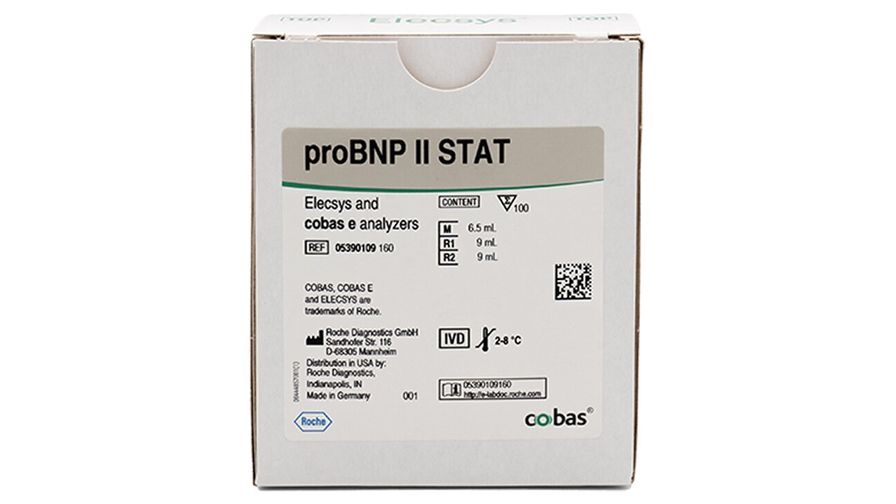
For in vitro diagnostic use. Others Elecsys proBNP II STAT IVD Elecsys® proBNP II STAT CPS_000500 08 836 744 190 8 836 744 190 08836744190 8836744190 08836744190 proBNP G2 STAT Elecsys cobas e 100 V2 Elecsys proBNP II STAT 07613336166918 Reagents, kits 100 tests cobas e 601/602 true 09 315 276 190 9 315 276 190 09315276190 9315276190 09315276190 proBNP G2 STAT Elecsys cobas e 100 V2.1 Elecsys proBNP II STAT 07613336191514 Reagents, kits 100 tests cobas e 601/602 true 08836744500 Elecsys proBNP II STAT de 3 FF0000000472CE0A FF00000003C2C10A 08836744190 2325 cobas e 602 619 cobas e 601 Die auf dieser Seite aufgeführten Produktinformationen enthalten Elemente aus dem offiziell veröffentlichen Methodenblatt. Weitere Informationen erhalten Sie im vollständigen Methodenblatt im PDF-Format unter dem angegebenen Link oder alternativ von Ihrer Roche Ländervertretung. AnwendungszweckImmunologischer In-vitro-Test zur quantitativen Bestimmung von N‑terminalem pro‑B‑Typ natriuretischem Peptid in Humanserum und ‑plasma. Dieser Test dient als Hilfsmittel bei der Diagnose von Personen mit Verdacht auf dekompensierte Herzinsuffizienz und beim Nachweis von milden Formen einer kardialen Funktionsstörung.LREFPonikowski P, Voors AA, Anker SD, et al. 2016 ESC Guidelines for the diagnosis and treatment of acute and chronic heart failure.Eur J Heart Fail 2016;18(8):891-975.,LREFYancy CW, Jessup M, Bozkurt B, et al. 2013 ACCF/AHA guideline for the management of heart failure: a report of the American College of Cardiology. Foundation/American Heart Association Task Force on practice guidelines. Circulation 2013 15;128(16):1810-1852.,LREFRutten FH, Taylor CJ, Judith R, et al. Practical Guidance on Heart Failure Diagnosis and Management in Primary Care. European Primary Care Cardiovascular Society | Version 22-09-2016. http://www.epccs.eu/bestanden/b8695636106717584158253-EPCCS-2016-HF-Diagnosis-webversion.pdf,LREFMueller T, Gegenhuber A, Poelz W, et al. Head-to-head comparison of the diagnostic utility of BNP and NT-proBNP in symptomatic and asymptomatic structural heart disease. Clin Chim Acta 2004;341:41-48.,LREFMcGrady M, Reid CM, Shiel L, et al. NT-proB natriuretic peptide, risk factors and asymptomatic left ventricular dysfunction: results of the SCReening Evaluation of the Evolution of New Heart Failure study (SCREEN-HF). Int J of Card 2013;169(2):133-138.,LREFCostello-Boerrigter LC, Boerrigter G, Redfield MM, et al. Amino- terminal pro-B-type natriuretic peptide and B-type natriuretic peptide in the general community: determinants and detection of left ventricular dysfunction. J Am Coll Cardiol 2006;47(2):345-353.,LREFO'Donoghue M, Chen A, Baggish AL, et al. The effects of ejection fraction on N-terminal ProBNP and BNP levels in patients with acute CHF: analysis from the ProBNP Investigation of Dyspnea in the Emergency Department (PRIDE) study. Journ of Card Fail 2005;11(5):9-14.,LREFMureddu GF, Tarantini L, Agabiti N, et al. Evaluation of different strategies for identifying asymptomatic left ventricular dysfunction and pre-clinical (stage B) heart failure in the elderly. Results from ‘PREDICTOR’, a population based-study in central Italy European Journal of Heart Failure 2013;15:1102-1112.Der Test dient weiterhin als Hilfe bei der Beurteilung des Schweregrads einer Herzinsuffizienz bei Patienten mit diagnostizierter dekompensierter Herzinsuffizienz.LREFHunt PJ, Richards AM, Nicholls MG, et al. Immunoreactive amino terminal pro-brain natriuretic peptide (NT-PROBNP): a new marker of cardiac impairment. Clin Endocrinol 1997;47(3):287-296.,LREFJanuzzi JL, van Kimmenade R, Lainchbury J, et al. NT-proBNP testing for diagnosis and short-term prognosis in acute destabilized heart failure: an international pooled analysis of 1256 patients The International Collaborative of NT-proBNP Study Euro Heart Journ 2006;27(3):330-337. Außerdem dient dieser Test zur Risikostratifizierung von Patienten mit akutem KoronarsyndromLREFRichards AM, Nicholls GM, Yandle TG, et al. Plasma N-Terminal Pro- Brain Natriuretic Peptide and Adrenomedullin: New Neurohormonal Predictors of Left Ventricular Function and Prognosis After Myocardial Infarction. Circulation 1998;97:1921-1929.,LREFGalvani M, Ferrini D, Ottani F. Natriuretic peptides for risk stratification of patients with acute coronary sydromes. Eur J Heart Fail 2004;6:327-333.,LREFNørgaard BL, Terkelsen CJ, Riiskjaer M, et al. Risk prediction in acute coronary syndrome from serial inhospital measurements of N-terminal pro-B-type natriuretic peptide. Acute Card Care 2008;10:159-166.,LREFDallmeier D, Pencina MJ, Rajman I, et al. Serial measurements of N-terminal pro-brain natriuretic peptide in patients with coronary heart disease. PLoS One 2015;28;10(1):e0117143.,LREFJames SK, Lindahl B, Siegbahn A, et al. NT proBNP and other Risk Markers for the Separate Prediction of Mortality and Subsequent Myocardial Infarction in Patients with Unstable Coronary Artery Disease. GUSTO IV Substudy. Circulation 2003;108:275-281. und dekompensierter Herzinsuffizienz sowie zur Therapieüberwachung von Patienten mit linksventrikulärer Funktionsstörung.LREFPonikowski P, Voors AA, Anker SD, et al. 2016 ESC Guidelines for the diagnosis and treatment of acute and chronic heart failure.Eur J Heart Fail 2016;18(8):891-975.,LREFYancy CW, Jessup M, Bozkurt B, et al. 2013 ACCF/AHA guideline for the management of heart failure: a report of the American College of Cardiology. Foundation/American Heart Association Task Force on practice guidelines. Circulation 2013 15;128(16):1810-1852.,LREFBettencourt P, Azevedo A, Pimenta J, et al. N-Terminal-Pro-Brain Natriuretic Peptide Predicts Outcome After Hospital Discharge in. Circulation 2004;110(15):2168-2174.,LREFMasson S, Latini R, Anand IS, et al. Prognostic value of changes in N-terminal pro-brain natriuretic peptide in Val-HeFT (Valsartan Heart Failure Trial). J Am Coll Cardiol 2008;16;52(12):997-1003.,LREFJanuzzi JL, Throughton R. Are Serial BNP Measurements Useful in Heart Failure Management? Serial Natriuretic Peptide Measurements Are Useful in Heart Failure Management. Circulation 2013;127:500-508.,LREFMair J, Lindahl B, Giannitsis E, et al. Will sacubitril-valsartan diminish the clinical utility of B-type natriuretic peptide testing in acute cardiac care? 2016 12. Eur Heart J Acute Cardiovasc Care.,LREFZile MR, Claggett BL, Prescott MF, et al. Prognostic Implications of changes in N-Terminal Pro-B-Type Natriuretic Peptide in Patients With Heart Failure. J Am Coll Cardiol 2016;68:2425-2436. Der ElektroChemiLumineszenz-ImmunAssay (ECLIA) ist zur Durchführung auf den cobas e 601 und cobas e 602 Geräten für Immunassays vorgesehen. de 09315276500 Elecsys proBNP II STAT de 3 FF0000000630920A FF0000000477010A 09315276190 2325 cobas e 602 619 cobas e 601 Die auf dieser Seite aufgeführten Produktinformationen enthalten Elemente aus dem offiziell veröffentlichen Methodenblatt. Weitere Informationen erhalten Sie im vollständigen Methodenblatt im PDF-Format unter dem angegebenen Link oder alternativ von Ihrer Roche Ländervertretung. Anwendungszweck
Immunologischer In-vitro-Test zur quantitativen Bestimmung von N‑terminalem pro‑B‑Typ natriuretischem Peptid in Humanserum und ‑plasma. Dieser Test dient als Hilfsmittel bei der Diagnose von Personen mit Verdacht auf dekompensierte Herzinsuffizienz und beim Nachweis von milden Formen einer kardialen Funktionsstörung.Der Test dient weiterhin als Hilfe bei der Beurteilung des Schweregrads einer Herzinsuffizienz bei Patienten mit diagnostizierter dekompensierter Herzinsuffizienz. Außerdem dient dieser Test zur Risikostratifizierung von Patienten mit akutem Koronarsyndrom und dekompensierter Herzinsuffizienz sowie zur Therapieüberwachung von Patienten mit linksventrikulärer Funktionsstörung.Der Test kann die Beurteilung des kardiovaskulären Risikos bei Patienten mit Diabetes mellitus Typ 2 unterstützen. Der Test wird außerdem als Unterstützung bei der Identifizierung von Risikopatienten mit Diabetes mellitus Typ 2 ohne bekannte Vorgeschichte mit Herz-Kreislauf-Erkrankungen eingesetzt, um die kardioprotektive Behandlung zu optimieren.Dieser Test kann zur Identifizierung von älteren Personen mit hohem Risiko für Vorhofflimmern dienen.Der ElektroChemiLumineszenz-ImmunoAssay „ECLIA“ ist zur Durchführung auf cobas e 601 und cobas e 602 Immunoassay-Analyzern vorgesehen. de