For localized information and support, would you like to switch to your country-specific website for {0}?

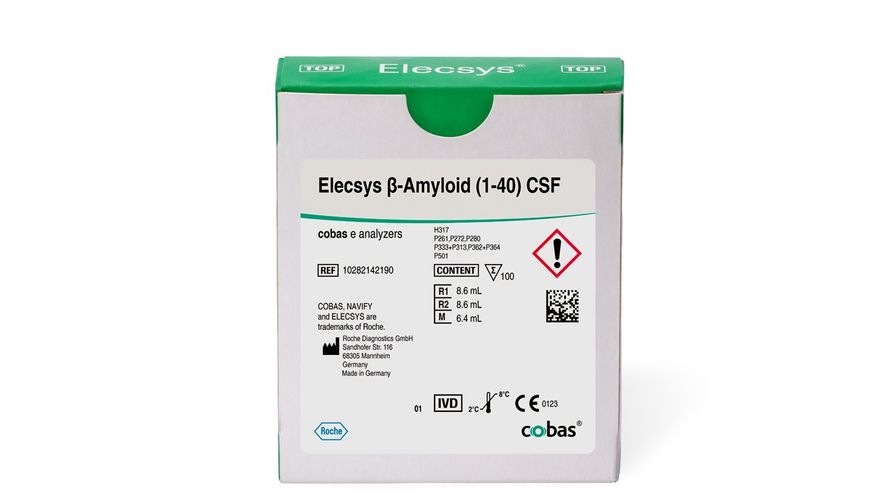
Elecsys® β-Amyloid (1-40) CSF
IVD
For in vitro diagnostic use.

Powering Alzheimer’s disease clarity
Alzheimer's disease (AD) is the most common cause of dementia, a progressive neurodegenerative disorder that severely impacts memory and cognition.1 In 2021, an estimated 57 million people worldwide were living with dementia, projecting a massive rise that creates a significant global healthcare and economic burden.1 As the seventh leading cause of death globally, the substantial costs of caregiving strain both health systems and families.1
Epidemiology and healthcare burden
AD is characterized by the accumulation of ß-amyloid (Aβ) plaques and tau protein tangles in the brain. Early symptoms are often nonspecific and overlap with other conditions, making a timely and accurate differential diagnosis challenging.1 Given the sheer number of affected individuals and the intensive long-term care required, AD represents one of the most pressing public health challenges worldwide.
?scl=1&fmt=png-alpha)
Pinpointing amyloid pathology
For effective patient management and access to new disease-modifying therapies, a definitive diagnosis is crucial. This is achieved by measuring specific cerebrospinal fluid (CSF) biomarkers and the following ratios: Aß42, Aß42/Aß40 ratio, total Tau (t-Tau), phosphorylated Tau (p-Tau), and the p-Tau/Aß42, t-Tau/Aß42 ratios.2
Clarity with single cut-offs: The power of simplicity
Relying on single Aβ42 concentrations can be problematic due to analytical and pre-analytical variability.3 Ratio biomarkers, however, significantly improve diagnostic accuracy and concordance with positron emission tomography (PET) imaging.3,4 Assays that utilize single, validated cut-offs for ratios offer superior clarity and confidence in confirming amyloid pathology.
- Aβ42/Aβ40 Ratio: This ratio is superior to Aβ42 alone for detecting brain amyloid deposition, even in the prodromal stage of AD, and for differentiating AD from other dementias.3,4
- pTau/Aβ42 and tTau/Aβ42 Ratios: Normalizing Tau markers to Aβ42 enhances diagnostic performance. These ratios provide a reliable method to confirm both core pathological changes, amyloid and tau proteinopathies—hallmarks of Alzheimer's Disease—showing slightly stronger concordance with amyloid PET.5
Accurate, reliable CSF assay results, powered by these ratios and a single cut-off, give clinicians the definitive diagnosis with confidence needed for optimized patient care and clinical trial recruitment.4
This is the power of clarity, built on a foundation of trust.
Use left and right arrow keys to scroll between the tabs
Overview
Product specifications
View full tableProduct specifications
Product specification |
Value |
|---|---|
Systems |
cobas® e 402 analytical unit, cobas® e 801 analytical unit |
Testing time |
18 minutes |
Sample material |
Cerebrospinal fluid (CSF) |
Sample volume |
12 µL |
Technical documents
Access important product documentation including relevant certificates and other resources.
After clicking below, you will be redirected to eLabDoc, where you can select your local country-specific documents.


References
- World Health Organization (WHO). Dementia: Key facts [Internet; cited 2025 Nov 24] . Available from: https://www.who.int/news-room/fact-sheets/detail/dementia
- Leuzy A, et al. Considerations in the clinical use of amyloid PET and CSF biomarkers for Alzheimer's disease. Alzheimers Dement. 2025 Mar;21(3):e14528. doi: 10.1002/alz.14528. PMID: 40042435; PMCID: PMC11881640.
- Lewczuk P, et al. Cerebrospinal fluid Abeta42/Abeta40 corresponds better than Abeta42 to amyloid PET in Alzheimer’s disease. Journal of Alzheimer's Disease. 2017;55(2):813-822.
- Lehmann, S. et al. Relevance of Abeta42/Abeta40 Ratio for Detection of Alzheimer Disease Pathology in Clinical Routine: The PLMR Scale. Frontiers in Aging Neuroscience. 2018;10:138
- Bellelli F, et al. Hallmarks of aging and Alzheimer's Disease pathogenesis: Paving the route for new therapeutic targets. Ageing Res Rev. 2025;106:102699.
- F. Hoffmann-La Roche Ltd. Elecsys® β-Amyloid (1-40) CSF Method sheet. (v1.0). 2025.
- Frisoni G, et al. European intersocietal recommendations for the biomarker-based diagnosis of neurocognitive disorders. The Lancet Neurology. 2024;23:302-312.
- The Lancet Neurology. Dementia diagnosis in the anti-amyloid era. 2024;23:219.