For localized information and support, would you like to switch to your country-specific website for {0}?


Low-bias library amplification and accurate library quantification improve data quality
To ensure high sequencing data quality and yields, both library amplification (when appropriate) and library quantification must be performed with high accuracy, low bias, and high efficiency. KAPA library amplification and NGS library quantification enzyme mixes contain enzymes purposefully engineered for efficiency for a wide range of GC contents and fragment sizes.
KAPA HiFi DNA Polymerase, the enzyme contained in KAPA EvoAmp ReadyMixes and updated KAPA Library Amplification Kits, offers ultra-high fidelity to mitigate against the introduction of errors during NGS library amplification.1 KAPA Library Quantification Kits contain the engineered KAPA SYBR FAST enzyme, engineered for robust and reproducible SYBR Green I-based qPCR.2
NGS library amplification
Most NGS workflows include at least one library amplification step; this includes DNA workflows (except PCR-free WGS), most RNA-seq workflows, and most targeted NGS workflows. The roles of library amplification in NGS library prep are:
- Generate sufficient material for the next step in the workflow; for example, to increase the ability to detect low-abundance cDNAs or to increase sample mass prior to target enrichment
- Add NGS index sequences when truncated universal adapters are used to convert DNA or cDNA fragments to library molecules (full-length adapters contain indexes, and may be used when PCR-free workflows are desired)
Thus, accurate and low-bias library amplification is essential to ensure that the final data represents the original sample, especially when the input DNA consists of low amounts or poor-quality nucleic acids such as ctDNA or FFPET DNA, which can require more rounds of amplification.
NGS library quantification
Quantification of NGS library quantification may be performed at multiple stages in a workflow. For example,
- Quantification of indexed libraries prior to pooling for target enrichment (multiplexed capture) ensures that each sample is represented equally in the capture reaction.
- Quantification of post-capture libraries or of un-enriched libraries prior to sequencing helps to ensure optimal cluster generation on the instrument, which is important for both sequencing efficiency and data quality.
qPCR-based methods, such as the KAPA Library Quantification Kit, are more accurate at quantifying sequenceable library molecules than other methods, such as fluorometer or electrophoretic methods, as they only recognize sequenceable library fragments; the other methods will also include incomplete library fragments in their output.
Featured products
RUO
For Research Use Only. Not for use in diagnostic procedures.
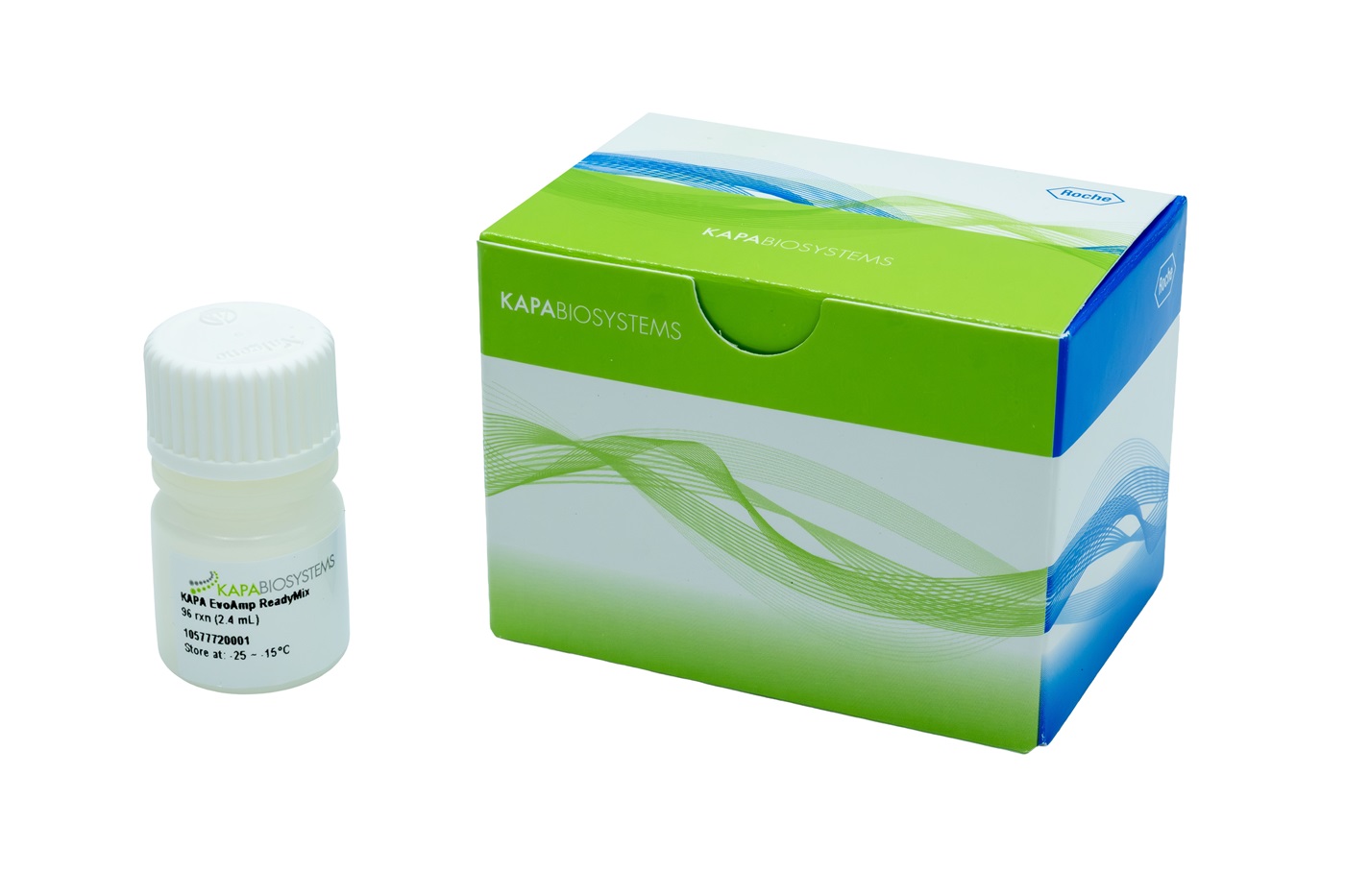
KAPA Library Amplification Kits
KAPA Library Amplification Kits are next-generation solutions for NGS library amplification, delivering uniformity across the GC-range, and high-fidelity results.
RUO
For Research Use Only. Not for use in diagnostic procedures.
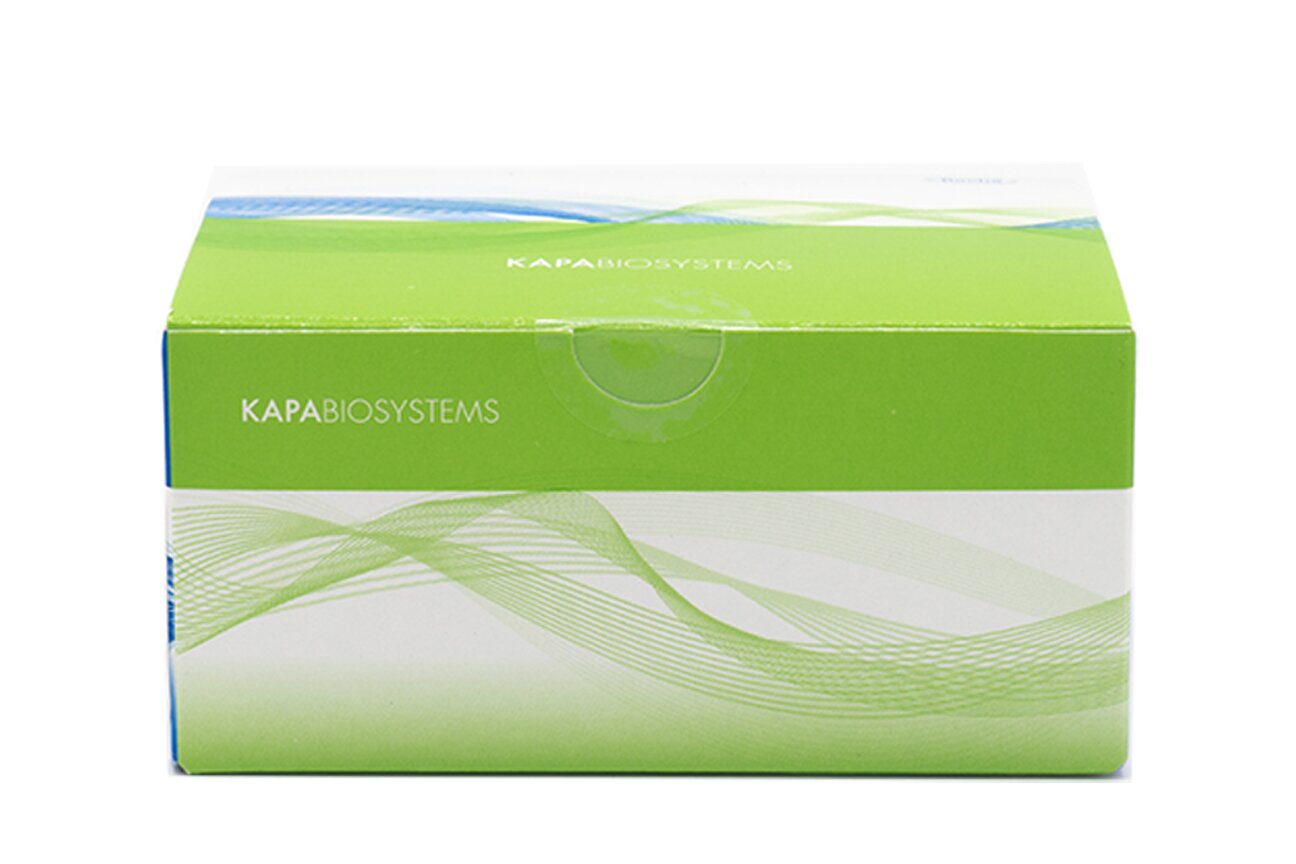
KAPA Library Quantification Kits
KAPA Library Quantification Kits are a complete solution for accurate, reliable and reproducible qPCR-based quantification of NGS libraries.
RUO
For Research Use Only. Not for use in diagnostic procedures.
KAPA EvoAmp ReadyMix
KAPA EvoAmp ReadyMix contains KAPA HiFi HotStart DNA Polymerase that is specifically designed to minimize amplification bias, while maintaining extremely high fidelity.
The KAPA EvoAmp ReadyMix is designed for efficient library amplification of adapter-ligated libraries for next-generation sequencing (NGS).
KAPA EvoAmp ReadyMix is compatible with libraries constructed from input DNA amounts of 0.1 ng to 500 ng (high quality DNA). It is compatible with high-quality gDNA, cfDNA and low-quality DNA such as that extracted from formalin-fixed, paraffinembedded tissue (FFPET) samples. The KAPA EvoAmp ReadyMix Kits are designed for the amplification of next-generation sequencing (NGS) libraries prepared for Illumina sequencing. The KAPA EvoAmp ReadyMix Kits are ideally suited for high-efficiency, high fidelity, low-bias amplification of libraries prior to Illumina sequencing.This includes libraries prepared for Whole-genome sequencing (WGS) and Whole exome sequencing (WES) or targeted sequencing. KAPA EvoAmp ReadyMix Kits which are powered by KAPA HiFi HotStart build on the existing performance of KAPA HiFi which is ideally suited for high-efficiency, high fidelity, low-bias amplification of libraries prior to Illumina sequencing.
This includes libraries prepared for:
whole-genome shotgun sequencing
exome or targeted sequencing (pre- and post-capture amplification)
RNA-seq
ChIP-seq
other sequencing applications
In order to maximize sequence coverage uniformity, it is critical to minimize library amplification bias. Amplification bias occurs when a DNA polymerase is unable to amplify all targets within a complex population of library DNA with equal efficiency. KAPA HiFi DNA Polymerase is a B-family DNA polymerase engineered for increased processivity, extremely high fidelity and low-bias, and is the reagent of choice for NGS library amplification.1,2,3,4 KAPA HiFi HotStart DNA Polymerase has 5’→3’ polymerase and 3’→5’ exonuclease (proofreading) activities. The error rate of KAPA HiFi HotStart DNA Polymerase is 2.8 x 10⁻⁷ errors/ base, equivalent to 1 error per 3.5 x 10⁶ nucleotides incorporated. The enzyme is combined with a proprietary antibody that inactivates the enzyme until the first denaturation step. This prevents nonspecific amplification during reaction setup, increases sensitivity, and improves reaction efficiency. KAPA EvoAmp ReadyMix, a ready-to-use Library Amplification mix comprising all the components for library amplification; except primers and template.
1. Oyola, S.O., et al., BMC Genomics 13, 1 (2012).
2. Quail, M.A., et al., Nature Methods 9, 10 (2012).
3. Quail, M.A., et al., BMC Genomics 13, 341 (2012).
4. Ross, M.G., et al., Genome Biology 14, R51 (2013).
Benefits of NGS library amplification and quantification solutions from Roche
Low bias
High-efficiency, low-bias amplification for all NGS workflows requiring PCR
PCR with traditional DNA polymerases is known to introduce bias, thereby compromising NGS data.3 Roche's KAPA library amplification solutions contain the engineered KAPA HiFi DNA Polymerase, valued in NGS library amplification due to its ability to amplify complex DNA populations with ultra-high fidelity, high efficiency, and low bias.4
- KAPA EvoAmp ReadyMix, KAPA HiFi HotStart ReadyMix, and all KAPA Library Amplification Kits offer high amplification efficiency across a wide range of fragment lengths, GC contents, and sequencing motifs, thereby reducing the amount of PCR cycles needed to achieve high success rates with routine and challenging samples5
- Highly-efficient, low-bias amplification preserves NGS library complexity to ensure sequencing results that are representative of the original sample
- Low bias amplification is essential for achieving high coverage uniformity, which reduces dropout and duplication rates and contributes to improved sequencing economy6
Ultra-high fidelity
Low amplification error rates translate to high-accuracy NGS data
PCR-based NGS library amplification is error-prone, in part due to the inherent properties of DNA polymerases.1 KAPA HiFi DNA Polymerase was derived from a B-family polymerase and engineered to display enhanced 3’→5’ exonuclease (proofreading) activity.
- NGS library amplification with Roche’s KAPA library amplification solutions reduces the total number of errors that accumulate during the sample preparation process, resulting in more accurate sequencing results.
- Ultra-high-fidelity library amplification simplifies NGS data analysis and interpretation and minimizes the need for additional error correction strategies across the sample-to-sequence process.
Cost-effective
Reliable NGS library quantification enables optimal utilization of sequencing capacity
Sequencing still constitutes a significant portion of the overall cost of any project, particularly when high coverage or deep sequencing is required. To achieve optimal sequencing economy, it is important to obtain an optimal amount of data from every sequencing run, as well as the desired number of reads from each sample in the run.
KAPA Library Quantification Kits provide an effective, qPCR-based solution for quantifying NGS libraries. Easily implemented in any molecular biology laboratory, these kits are ideal for the routine quantification of individual libraries or pooled samples before sequencing or target enrichment.
- Unlike other quantification methods, such as those employing UV spectroscopy, fluorometry, or electrophoresis, NGS library quantification by qPCR counts only those library molecules with both adapters in the correct orientation for sequencing
- Kits employ a single, pre-diluted DNA standard for all library types and undergo strict quality control to ensure batch-to-batch consistency and mitigate against data drift
- KAPA Library Quantification Kits do not require any specialized equipment or skills and are highly amenable to automation
KAPA products are for Research Use Only, not for use in diagnostics procedures.
References
- F. Hoffmann-La Roche Ltd. Data on file.
- F. Hoffmann-La Roche Ltd. Data on file.
- Quail MA, et al. Optimal enzymes for amplifying sequencing libraries. Nat Methods. 2011;9(1):10-1.
- F. Hoffmann-La Roche Ltd. Data on file.
- F. Hoffmann-La Roche Ltd. Data on file.
- F. Hoffmann-La Roche Ltd. Data on file.
- McInerney P, et al. Error Rate Comparison during Polymerase Chain Reaction by DNA Polymerase. Mol Biol Int. 2014;:287430.