For localized information and support, would you like to switch to your country-specific website for {0}?
KAPA EvoPrep Boost Kits
DNA library prep kits for mechanically or naturally-fragmented DNA
RUO
For Research Use Only. Not for use in diagnostic procedures.
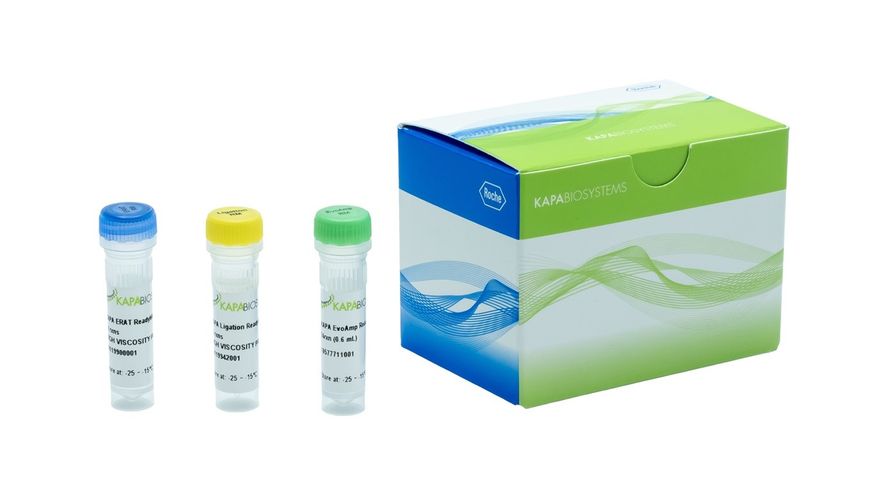
High-performing NGS library prep for pre-fragmented DNA
Built on Roche’s advanced Evo chemistry, KAPA EvoPrep Boost Kits are designed for the preparation of high-quality NGS libraries with a streamlined, automation-friendly workflow that requires minimal hands-on time and fewer reagent manipulations. KAPA EvoPrep Boost Kits offer the same industry-leading performance as KAPA EvoPlus Boost Kits, but for fragmented DNA inputs. This includes mechanically sheared DNA, challenging samples such as cell-free DNA (cfDNA) and DNA from FFPE tissue (FFET), and PCR amplicons.
KAPA EvoPrep Boost Kits are validated with KAPA UDI and KAPA HyperPlex adapters and KAPA HyperPure Beads (sold separately), as well as KAPA target enrichment workflows and probes. The core KAPA EvoPrep Boost, PCR-free is ideally suited for human whole genome sequencing from mechanically sheared DNA. The KAPA EvoPrep Boost Kit contains the new KAPA EvoAmp ReadyMix powered by HiFi, to achieve exceptional fidelity and coverage uniformity in whole exome sequencing, targeted sequencing, methyl-seq, and other workflows that require one or more library amplification steps.
Irrespective of your application, KAPA EvoPrep Boost Kits enable robust and reliable results, while supporting laboratory efficiency and sustainability.
KAPA EvoPrep Boost Kits specifications
View full tableKAPA EvoPrep Boost Kits specifications
| Product specifications | Value |
| Compatible platform | All Illumina sequencing instruments |
| Application | WGS, WES, targeted sequencing, methyl-seq |
| Starting material | Fragmented DNA, cfDNA, FFPE DNA, PCR amplicons |
| Input amount | 0.1 ng - 500 ng* |
| Storage conditions | Kits must be stored at -15°C to -20°C |
KAPA EvoPrep Boost Kits comparison overview
View full tableKAPA EvoPrep Boost Kits comparison overview
| Cap or plate colour | Component name | Included in KAPA EvoPrep Boost Kits (10613653001, 10613661001, 10613670001, 10613688001)
|
Included in KAPA EvoPrep Boost Kits (PCR-free) (10153806001, 10153814001, 10153857001, 10154284001) |
| Blue | End Repair and A-Tailing ReadyMix | Yes | Yes |
| Yellow | Ligation ReadyMix | Yes | Yes |
| Green | KAPA EvoAmp ReadyMix pwd by HiFi (2X) | Yes | No |
| Green | KAPA Library Amplification Primer Mix (10X) | No | No |
KAPA EvoPrep Boost Kit for liquid biopsy applications
playicon
videoCtrl
/
fullScreen
Update Required
To play the media you will need to either update your browser to a recent version or update your
Flash plugin.
Liquid biopsies offer crucial cancer insights, but low input and DNA degradation pose challenges. The KAPA EvoPrep Boost Kit refines NGS library prep using the KAPA EvoT4 DNA Ligase and KAPA EvoAmp ReadyMix to recover more unique molecules and improve variant detection from cell-free DNA.
Show video transcript
KAPA DNA library prep kits comparison overview

KAPA EvoPlus Boost Kit
|
KAPA EvoPlus Boost Kit PCR-free
|
KAPA EvoPrep Boost Kit
|
KAPA EvoPrep Boost Kit, PCR-free
|
| Recommended sample types | |||
|
Genomic DNA, FFPE DNA
|
Genomic DNA
|
Genomic DNA, cfDNA, FFPE DNA
|
Genomic DNA
|
| Input range* | |||
|
100 pg - 500 ng
|
50 ng - 500 ng
|
100 pg - 500 ng
|
50 ng - 500 ng
|
| Fragmentation method (if required) | |||
|
Enzymatic fragmentation (integrated)
|
Enzymatic fragmentation (integrated)
|
Mechanical shearing
|
Mechanical shearing
|
| Library Amplification reagent | |||
|
KAPA EvoAmp ReadyMix, powered by HiFi
|
None
|
KAPA EvoAmp ReadyMix, powered by HiFi
|
None
|
| Adapter compatibility | |||
|
KAPA UDI Adapters, KAPA HyperPlex Adapters
|
KAPA UDI Adapters
|
KAPA UDI Adapters, KAPA HyperPlex Adapters
|
KAPA UDI Adapters
|
| Key applications | |||
|
WGS, WES, targeted sequencing
|
WGS
|
WGS, WES, and targeted sequencing Metyl-seq
|
WGS
|
*Dependent upon input sample type, amount, and quality.
Use left and right arrow keys to scroll between the tabs
Products
Technical documents
Access important product documentation including relevant certificates and other resources.
After clicking below, you will be redirected to eLabDoc, where you can select your local country-specific documents.



Automation-friendly NGS library preparation
Thinking of automating library preparation? Roche provides NGS automation support with a menu of automated methods for KAPA library prep reagents on non-Roche liquid handling vendors, and on Roche's AVENIO Edge System.
KAPA products are for Research Use Only. Not for use in diagnostics procedures.
The AVENIO Edge System is a Class 1 US IVD and a Class A CE IVDR and is intended for downstream diagnostic applications. For the EU, Roche is collaborating with Platomics to enable laboratories to help automate document generation on Platomics multi-stakeholder platform for workflows incorporating the AVENIO Edge System. Reagents and kits mentioned are for Research Use Only. They are not intended for diagnostic procedures. The AVENIO Edge System can be used for Research Use Only (RUO) workflows.
References
- F. Hoffmann-La Roche Ltd. Data on file.
- Piovesan A, et al. On the length, weight, and GC content of the human genome. BMC Res Notes. 2019;12(1):106.
- Bowden KE, et al. Genome Structural Diversity among 31 Bordetella pertussis Isolates from Two Recent U.S. Whooping Cough Statewide Epidemics. mSphere. 2016;1:10.
- Chen et al. Characterization and mitigation of artifacts derived from NGS library preparation due to structure-specific sequences in the human genome. BMC Genomics. 2024;25:227.
- Haile S, et al. Sources of erroneous sequences and artifact chimeric reads in next generation sequencing of genomic DNA from formalin-fixed paraffin-embedded samples. Nucleic Acids Res. 2019;47(2):e12.
- McNulty SN, et al. Impact of reducing DNA input on next-generation sequencing library complexity and variant detection. J Mol Diagn. 2020;22(5):720-727.