

Anticoagulation treatment: Why are anticoagulants prescribed?
The human body has a complex mechanism called coagulation that causes blood to clot if a wound occurs. Under normal circumstances this is desirable; it allows the body to heal itself. Yet in some clinical conditions, coagulation can cause unwanted blood clots that may lead to complications and can be life threatening.
Oral anticoagulants, such as warfarin and phenprocoumon, are used to prevent blood clots and are often referred to as "blood thinners".
Anticoagulants are commonly prescribed for the following conditions:1-3
- Atrial fibrillation (irregular heartbeat)
- Mechanical heart valves
- Stroke
- Venous thromboembolism
- Thrombophilia (tendency to cause blood clots)
- Heart attack
What are INR values and why are they important?
Monitoring your therapy
When prescribed anticoagulation therapy, such as the use of a vitamin K antagonist (VKA), taking the correct dose is crucial for effective treatment. The correct dose is established by measuring how long it takes your blood to clot. This is called the International Normalized Ratio (INR).4
Understanding INR values
An INR of 1 is normal in healthy individuals who are not taking anticoagulants5
An INR of 2 means that your blood takes twice as long to clot as normal5
The therapeutic INR range for patients on anticogulation therapy can vary depending on the indication VKAs are prescribed for. However, the target range is commonly between 2.0-3.05-7
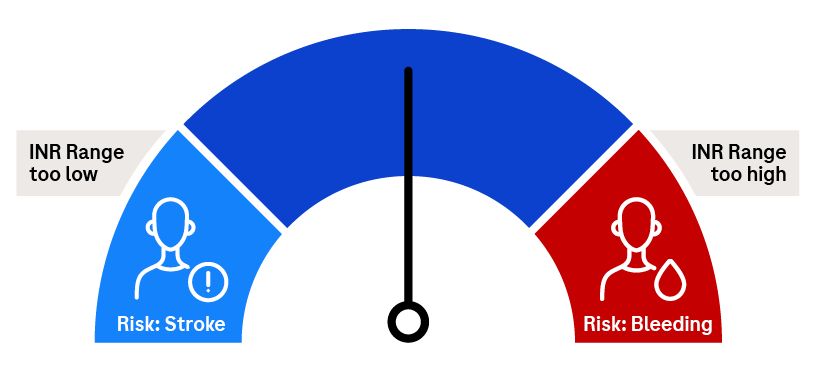
If the INR is too low, there is an increased risk of blood clots that can lead to stroke8,9
If the INR is too high, there is an increased risk of bleeding8
Keeping your INR in range is key. Know your value.
Regular INR monitoring is important to help determine if your dose needs to be adjusted. Your doctor will provide you with a target INR range. For people taking VKAs, which include warfarin, the target INR typically ranges from 2 to 3, but may be different depending on the patient and his or her condition.5-7
Vitamin K antagonisits at a glance

Considerations
- VKAs belong to the group of most frequently used drugs worldwide10
- Must be regularly monitored10
- May be prescribed for a period of weeks, months or years
How it's administered
Oral tablet
Available vitamin K antagonists (VKAs)
Warfarin, phenprocoumon and acenocoumarol
Contributors

Roche Diagnostics
Roche Diagnostics is a division of Roche, developing and integrating diagnostic solutions that address today’s healthcare challenges while anticipating tomorrow’s needs. In more than 100 countries, we provide one of the industry’s most comprehensive in vitro diagnostics portfolios spanning molecular diagnostics, clinical chemistry and immunoassays, tissue diagnostics, Point of Care testing, patient self-testing, next-generation sequencing, laboratory automation and IT, as well as digital health and decision-support solutions.
Our articles are authored by Roche Diagnostics subject matter experts, drawing on collective expertise across multiple disciplines to provide reliable insights for healthcare professionals worldwide.
Explore articles from our community


Abbreviations
INR: International Normalized Ratio
References
- Ryan et al. (2008). J Clin Pharm Ther 33, 581-590
- Stevens et al. (2016). J Thromb Thombolysis 41, 154-164
- Lip et al (2002). BMJ 325, 1022-1025
- Wardrop amd Keeling. (2008). Br J Haem 141, 757–763
- Institute for Quality and Efficiency in Health Care (IOWiG) (2017); Book available from: https://www.ncbi.nlm.nih.gov/books/NBK279434/ [Accessed May 2023]
- Shikdar and Bhattacharya (2018); Book available from: https://www.ncbi.nlm.nih.gov/books/NBK507707/ [Accessed May 2023]
- Tidman et al. (2015). Aust Precr 38, 44-48
- American Heart Association. Article available from: https://www.heart.org/en/health-topics/arrhythmia/prevention--treatment-of-arrhythmia/a-patients-guide-to-taking-warfarin [Accessed May 2023]
- North American Thrombosis Forum. Available from: https://thrombosis.org/2020/11/guide-inr-levels/ [Accessed May 2023]
- Ufer. (2005). Clin Pharmacokinet 44, 1227-1246