
Alzheimer's disease: For healthcare professionals

Unlocking the power of an early diagnosis and the potential of intervention for more patients
When it comes to Alzheimer’s, an early diagnosis is key to helping patients and their families make informed choices and plan for the future, and enabling clinicians to deliver personalized, patient-centric care.
It is estimated that each day nearly 2,000 patients age 65+ will progress from mild to moderate dementia1—meaning that a timely diagnosis and therapeutic intervention time are of the essence.
It has been shown that higher intensity lifestyle interventions in individuals at high risk of cognitive decline and dementia had a statistically significant greater benefit on global cognition.14 Recently approved new therapies demonstrated to be most effective in slowing down cognitive decline and delaying AD progression, when implemented in early disease stages (i.e., MCI and mild dementia).12,13
Therefore, it is of utmost significance to educate patients on new technologies available for disease detection, possibilities for management and therapies and for healthcare providers to use these recent advances to guide diagnosis and patient management.
Helping address unmet needs in diagnosing Alzheimer’s disease
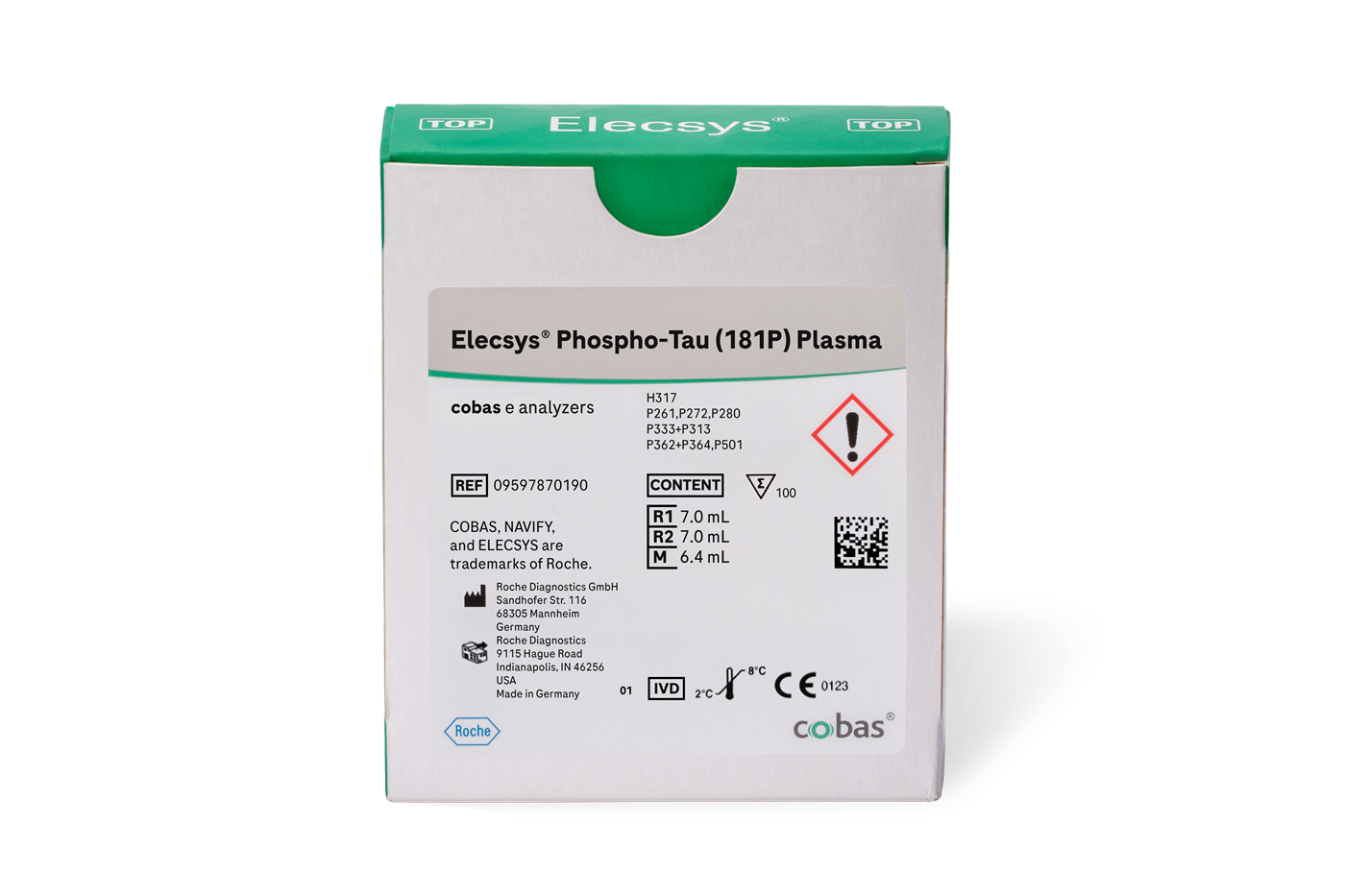
Elecsys pTau181 plasma11
A blood-based test intended as a rule-out test for amyloid pathology in primary care that features a 97.9% negative predictive value. While a negative test result is consistent with a negative amyloid PET, a positive result indicates that patients should be further investigated to determine whether the amyloid pathology can be a cause of cognitive impairment.
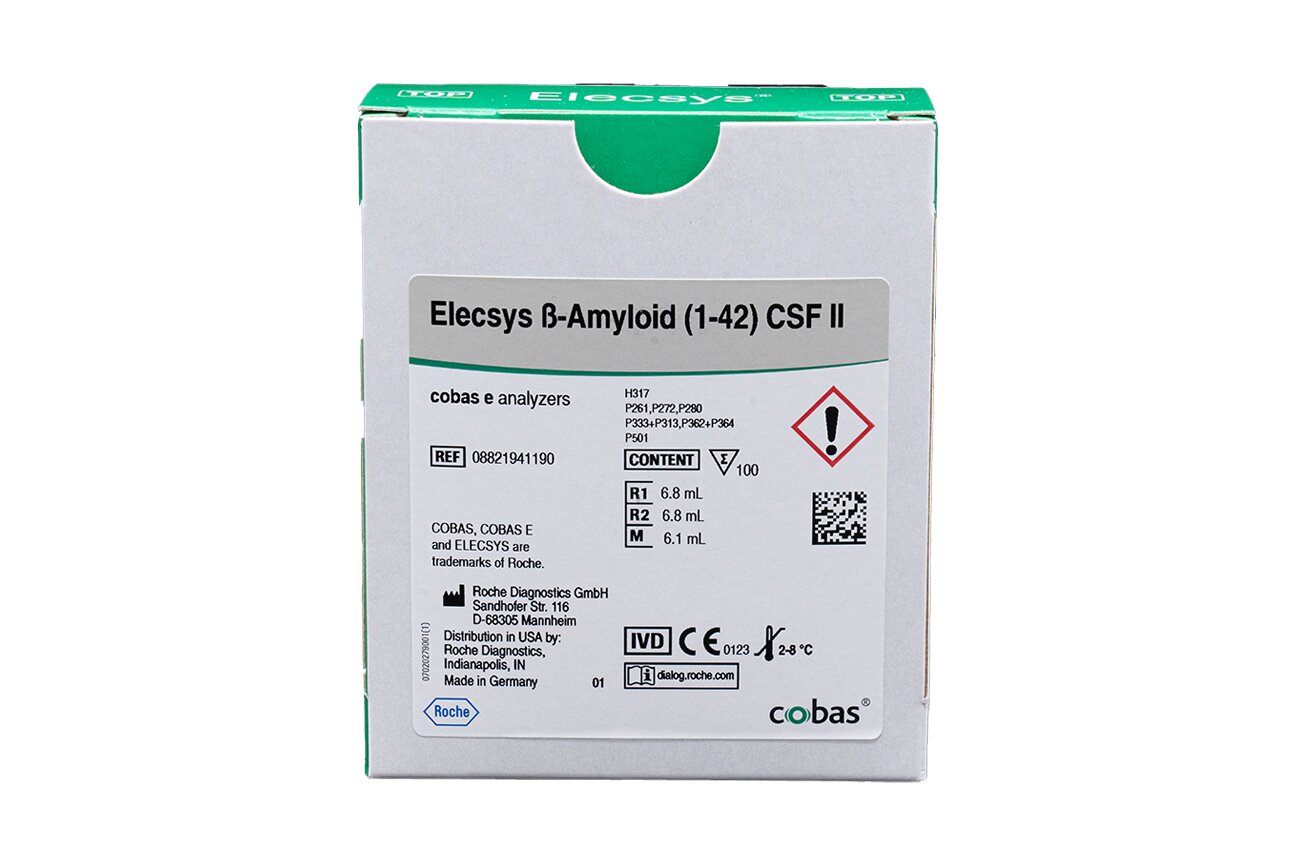
Elecsys pTau181/AB42 CSF ratio9
A cerebrospinal fluid test with a 90% concordance with amyloid PET scan that’s intended to assess patients' amyloid pathology status, either as an initial test, or following a triage rule/out test. A positive result is consistent with a positive amyloid PET scan result.
Elecsys tTau/AB42 CSF ratio10
A cerebrospinal fluid test with a 90% concordance with amyloid PET scan that’s intended to assess patients' amyloid pathology status, either as an initial test, or following a triage rule/out test. A positive result is consistent with a positive amyloid PET scan result.
Roche is blazing new trails in the future of Alzheimer’s testing
Roche’s Elecsys pTau181 Plasma test can help expand integration of primary care practitioners into the Alzheimer’s diagnosis pathway, enabling neurologists and dementia specialists to focus their expertise and resources on patients who may benefit the most from their advanced evaluation and treatment capabilities.
As the only rule-out test indicated for primary care, a negative test result indicates that a patient is not likely to have underlying AD pathology, the Elecsys pTau181 test may help optimize the use of more complex and costly confirmatory tests (e.g., PET scans and CSF testing), reducing the overall diagnostic burden on patients and healthcare systems to potentially shorten the time to diagnosis.
Roche’s Elecsys pTau181 Plasma blood test is designed to aid in the initial assessment for Alzheimer’s disease and other causes of cognitive decline in adult patients aged 55 years and older, presenting with signs, symptoms, or complaints of cognitive decline. The result should be interpreted in conjunction with other clinical information.9

NOTE: A positive test result may not be consistent with a positive amyloid PET scan result. Patients with an initial positive result should be further investigated to determine whether the amyloid pathology can be a cause of cognitive impairment.
Roche’s Elecsys pTau217 assay is in development
Roche’s Elecsys pTau217 assay is designed to offer a more comprehensive solution by identifying individuals with high likelihood for a positive, respectively negative amyloid PET scan/CSF result. The assay has received Breakthrough Device Designation from the U.S. Food and Drug Administration (FDA). Learn more
Four reasons to implement Roche’s BBM and CSF tests for Alzheimer’s disease testing
Increasing demand
New AD amyloid targeting therapies require early diagnosis and confirmation of amyloid pathology before initiation,15,16 reinforcing the value of these AD pathology specific assays for health systems and providers.
Reduces the patient burden for more invasive and costly testing options
By reducing reliance on more expensive testing (i.e., PET and CSF), AD blood tests may help to free up valuable testing resources and clinical expertise for use where they are needed most.
A faster path to diagnosis means help is within reach for more patients
Roche’s pTau181 blood test can be safely administered by a primary care doctor for the exclusion of AD pathology. Its use may therefore improve referral rates and facilitate early, timely diagnosis.
Accuracy
The Elecsys pTau181/Abeta42 and tTau/Abeta42 ratios and the Elecsys pTau181 plasma assay are traceable to reference materials to ensure accuracy of results.
Lab implementation
With 4,500 fully-automated immunoassay analyzers in the US, the AD assays are not only accessible but also scalable, giving patients broad access to high-quality testing in a timely manner.

Featured products

References
Alzheimer’s Association (alz.org), These are the facts about the Alzheimer’s Crisis, https://www.youtube.com/watch?v=Lta2-jvsWco&t=3s, Accessed 6 Oct 2025.
MedScape (medscape.com), Alzheimer's Prevalence Predicted to Double by 2050, P. Anderson, 26 March 2024 Alzheimer's Prevalence Predicted to Double by 2050, accessed 6 Oct 2025.
https://www.tandfonline.com/doi/epdf/10.2217/fnl-2023-0024?needAccess=true
https://pmc.ncbi.nlm.nih.gov/articles/PMC3622225/pdf/nihms437127.pdf
https://jamanetwork.com/journals/jamaneurology/fullarticle/1817720
https://www.accessdata.fda.gov/cdrh_docs/pdf22/K221842.pdf Accessed October 2025
https://www.accessdata.fda.gov/cdrh_docs/reviews/K231348.pdf Accessed October 2025
https://www.accessdata.fda.gov/cdrh_docs/reviews/K252163.pdf Accessed October 2025
https://www.accessdata.fda.gov/drugsatfda_docs/label/2023/761269Orig1s001lbl.pdf Accesed October 2025
https://www.accessdata.fda.gov/drugsatfda_docs/label/2025/761248s004lbl.pdf Accessed October 2025
https://www.sciencedirect.com/science/article/pii/S2274580725000949
- Alzheimer’s Association. 2024 Alzheimer’s Disease Facts and Figures. Alzheimer's Dement 2024;20(5).
- Alzheimer’s Association. Accessed July 1, 2023.
- Sabbagh MN, Lue LF, Fayard D, Shi J. Increasing Precision of Clinical Diagnosis of Alzheimer's Disease Using a Combined Algorithm Incorporating Clinical and Novel Biomarker Data. Neurol Ther. 2017 Jul;6(Suppl 1):83-95
- Elecsys® Method Sheets: ms_08846634501; ms_08821909501; ms_08846715501; ms_08846693501; ms_08821941501.