
Article
What is the future for tissue diagnostics in oncology?
Q&A with Audrey Bennett, M.D., Senior Medical Manager of Oncology at Roche Diagnostics
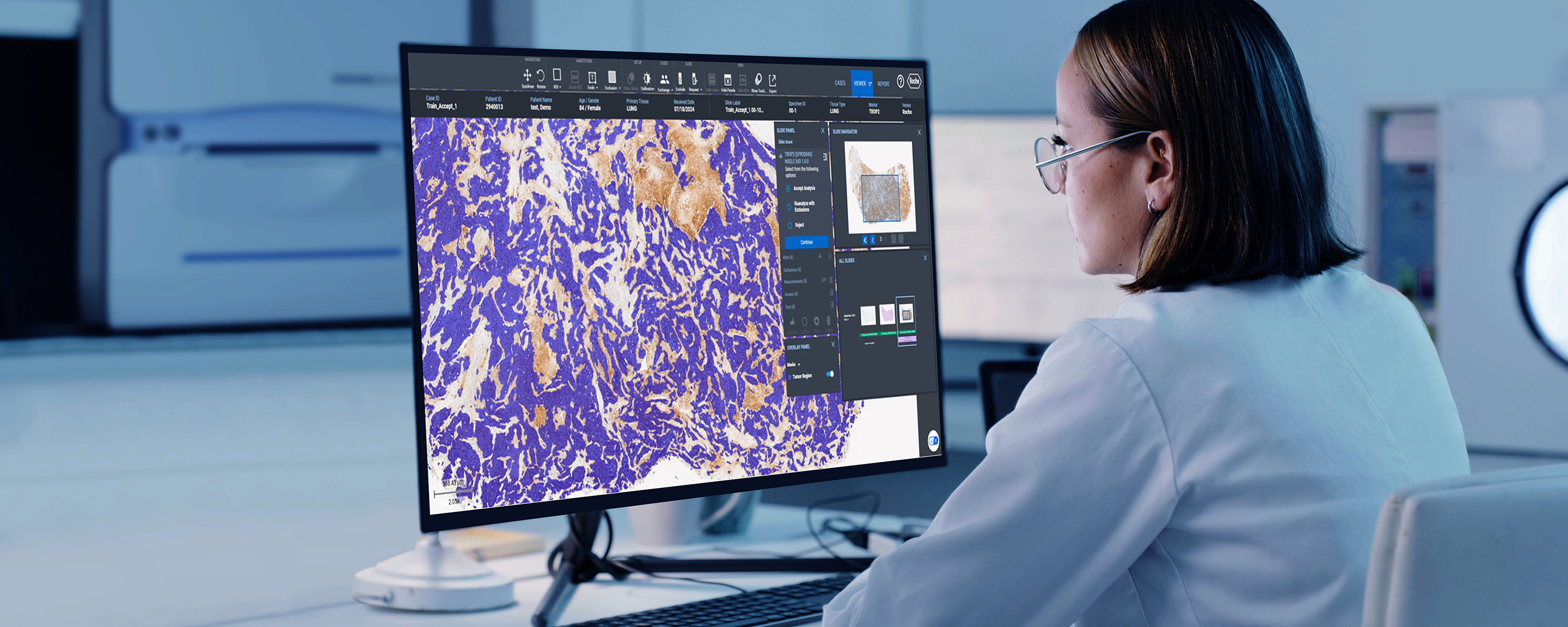
Roche tissue diagnostics continues to lead the way with the broadest IVD menu of ready-to-use assays in the industry. Audrey Bennett, M.D., FCAP, and senior medical manager for oncology, pathology and sequencing at Roche Diagnostics, provides some insight on the current state of tissue diagnostics and where it's heading.
Can you give us the big picture of where cancer diagnostics in pathology is now?
It’s a hopeful time for patients, clinicians and labs, not only for tissue diagnostics, but for cancer diagnostics in general. With the rapid pace of innovation in molecular and sequencing technology, much progress continues to be made in screening, early detection and monitoring of residual disease. These advancements in other areas of the lab are leading to earlier diagnosis for more patients, and earlier detection of disease recurrence. This expands the possibilities for healthcare and the precision of tissue diagnostics.
Over the last decade, the U.S. Food and Drug Administration (FDA) has approved an impressive number of companion diagnostic assays, across most cancer types. Companion diagnostic assays utilize predictive biomarkers to help establish patient eligibility for specific targeted therapies, based upon the biologic characteristics and biomarker expression of the tumor, rather than on the anatomic site of the tumor.
While science has made incredible progress in oncology over the past years, both in diagnostics and in targeted treatments, we’re really just skimming the surface of where we’ll be in a decade, in terms of how many patients we’ll be able to help with what was once thought of as a potentially terminal illness.
Future trends in tissue diagnostics

Multiplex Testing
Increasing the development and application of multiplex assays.

AI Adoption
Driving the use of digital pathology and AI image analysis algorithms.

CDx Evolution
Expanding companion diagnostics for multiple cancer types using a single biomarker (pan-tumor).

Biomarker Assessment
Capturing broader spectrums of expression.

Computational Pathology
Integrating companion diagnostics with advanced computational tools.
What existing tissue diagnostic trends will continue over the next two to five years?
In the pathology lab, we’ll see the continued need to assess biomarker status, to enable more patients to qualify for targeted therapies in all types of cancers, a few of which include HER2 in breast cancer, PD-L1 in lung and many other types of cancers, and FOLR-1 in ovarian cancer. These and new innovations will create greater opportunities to have a broader impact on patients, clinicians and laboratory professionals in oncology.
Biomarker expression scoring in tumors has evolved in terms of our understanding and our reporting. As an example, HER-2 IHC in breast cancer was previously scored as a binary positive or negative result, and now includes scoring across a spectrum of expression.1,2 By scoring HER2 across the entire range, including lower expression levels, more breast-cancer patients now have access to therapeutic options. Clinical trials are also evaluating how other biomarkers may follow a similar path to HER2 in expanding threshold cutoffs.
A notable trend is that of one biomarker being used across several different types of cancer, also known as a pan-tumor marker. This helps to establish actionable therapy based upon the biology of the tumor, rather than the site of origin of the tumor. Some biomarkers, such as PDL-1, are used in as many as a dozen types of cancer, and this trend is expected to continue. HER2 testing used to be for breast cancer only, but now it’s being used as a pan tumor marker in multiple tumor types, including lung, colon and endometrium, just to name a few.
All of this is at our doorstep. As the complexity of biomarker testing grows, we anticipate the expanded utility of digital pathology and application of AI tools, which contribute to our speed, accuracy and predictive ability in assessing biomarkers in oncology.
How long will it take for digital pathology to go mainstream?
It’s going to vary depending on the region, type of institution, healthcare system infrastructure and a lab’s capacity for capital investment. It also depends on whether we define digital pathology (DP) by scanning slides and digitizing pathology workflows, or if we include an entire system of slide scanners, image-management software, display monitors and AI-image analysis algorithms as well. While a digital workflow alone brings clinical utility, the real potential of digital pathology is unlocked with the ability to apply AI tools, supporting pathologists in faster and more accurate diagnosis, and enabling more precise and appropriate therapy selection.
Various reports put the adoption rate of digitization in the pathology lab at about 10%.3 While some larger academic labs are fully digitized, we’ve been pleasantly surprised by the number of small- to medium-size labs that have wholeheartedly embraced the entire DP package. They’ve shared a wide range of reasons for adopting digital pathology – from wanting quick, accurate results with shorter turnaround times to promoting their use of this technology to attract pathologists and histotechnologists, who are in short supply.4
What do you see as the most significant trends for digital and computational pathology in the next two to five years?
An important future trend is the merging of companion diagnostics with computational pathology, in which AI tools perform quantitative assessment that cannot be quantitatively scored by a pathologist’s eye alone. In 2025, the FDA granted Breakthrough Device Designation to Roche Diagnostics’ VENTANA® Trop2 RxDx device in Non-Small Cell Lung Cancer, for the first AI-driven companion diagnostic.5 This is only the beginning of the intersection of companion diagnostics with computational pathology, as there are many existing clinical trials in the pipelines of pharmaceutical and diagnostic companies. This reinforces the need for labs to digitize now to be ready for the future.

TROP2 Digital Pathology Analysis
The bottom section of this graphic displays a traditional TROP2 tissue stain, while the top section reveals the TROP2 (EPR20043) NSCLC RUO Algo* actively mapping and measuring those same tumor cells. This digital analysis generates a precise Normalized Membrane Ratio (NMR) score.
*Research Use Only, not for use in Diagnostic Procedures
What other innovations should we expect to see on the horizon?
We are looking forward to the emerging technology in multiplexing, which has the potential to expand diagnostic capabilities. Multiplexing uses two or more chromogens on the same slide to distinguish different cell populations, bringing clarity to diagnoses, and helping to better identify appropriate therapies while also conserving tissue.
There are a handful of FDA-cleared multiplexed tests, including the VENTANA® Kappa and Lambda Dual ISH mRNA Probe Cocktail.6 Some labs create their own laboratory-developed multiplex tests because so few are yet FDA approved. We look forward to AI tools playing a role in multiplex testing to assist with more precise interpretation.
Other testing methods, such as molecular mutational testing including genome sequencing, are also playing a significant role in detection, characterization and classification of malignancies, and in guiding treatment for cancer. Genomic sequencing is increasingly being used more frequently at all types of labs, not just in large reference labs or academic medical centers. Across testing types, the primary objective is to deliver faster and more accurate information to ensure optimal treatment for every patient. Cancer biomarkers, from their initial discovery to their current widespread adoption and expanding clinical utility, are driving the evolution of personalized healthcare.
References
- Roche receives FDA approval for first diagnostic tests to identify HER2-positive metastatic breast cancer patients eligible for ENHERTU. Roche news release, 2025.
- Roche receives FDA approval for the first companion diagnostic to identify patients with HER-ultralow metastic breast cancer eligible for ENHERTU. Roche news release, 2026.
- U.S. Digital Pathology: A deep dive into early clinical adopters’ successes and lessons learned. KLAS research, November 2023.
- The current troubled state of the global pathology workforce: a concise review. Diagnostics Pathology, December 2024.
- Roche granted FDA breakthrough device designation for first AI-driving companion diagnostic for non-small cell lung cancer. Roche news release, 2025.
- Roche receives FDA clearance for new, highly sensitive test to aid clinicians in diagnosing B-cell lymphoma. Roche news release, 2025.
Contributor

Audrey Bennett, M.D., FCAP, is a Pathologist and Senior Medical Manager in Medical and Scientific Affairs at Roche Diagnostics. Prior to Roche, Audrey was a practicing surgical pathologist in a community hospital for nearly 14 years. She did pathology residency training at the University of Virginia in anatomic and clinical pathology and obtained her medical degree at Northeastern Ohio Medical University.